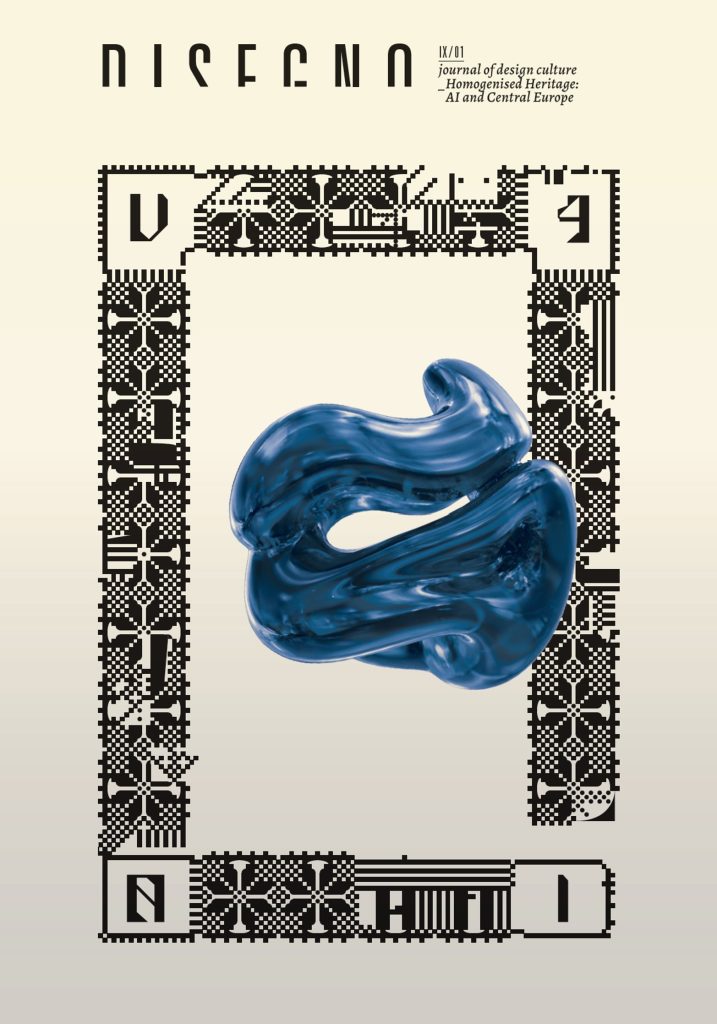
New issue on AI And Central Europe is out!

Artificial intelligence (AI) has come to occupy a pivotal place within contemporary design culture, reframing how images and texts are produced, circulated, classified, and made legible to publics and professionals alike. This issue foregrounds the infrastructures through which these processes reshape appearance, legibility, and social efficacy in culture, treating AI not merely as a tool but as an ambient mediator of cultural mediation and value production. The regional vantage of Central Europe and its Visegrád context sharpens this inquiry. The uneven presence of languages, visual archives, and everyday environments within dominant computational systems foregrounds very specific modalities of visibility and invisibility, including the post–Cold War archival history that continues to condition current digital infrastructures. The essays gathered here emerged from collaborative conversations across the region among authors committed to understanding how AI is altering the cultural conditions of visibility in Central Europe, and who recognised early on that this emergence urgently required concepts, cases, and attuned methods. The issue represents a regional effort to articulate a problem that has already become materially present while its vocabulary is still forming. The variety of approaches assembled here reflects the difficulty of grasping AI as a cultural condition from any single vantage point. Taken together, the studies suggest that what is at stake in the V4 regional context exceeds technical performance and questions of fairness taken in isolation. More fragile issues are involved: how cultures appearing in AI images can avoid homogenisation, and how cultural heritage is maintained within systems that increasingly organise collective knowledge. From this perspective, Central Europe is an important context, in which wider transformations in cultural mediation are observable with particular clarity.

The issue can be accessed here.

Call for Papers: The Obscure Design of Desire: The Design Culture of Pornography

“Art is like masturbation. It is selfish and introverted and done for you and you alone. Design is like sex,”goes the popular quote by Colin Wright. Would that it were so simple! Classical functionalists, and even Victor Papanek, saw their mission as defining and satisfying basic human needs “for the real world.” But can we speak of a definable human need in the case of the seemingly most animalistic one, sexuality? Or is it more a paradoxical entanglement of traditions, habiti, desires, and repressions? What kind of desires are these? And who designs their objects and subjects?

For the next issue of our journal we propose approaching the above subject from two perspectives.
One potentially observable aspect extends beyond the narrow area of pornography, involving wider societal issues. In a society where consumption is used to escape recession, we may be inclined to see the values created by contemporary design culture increasingly ephemeral and as tools of the over-eroticisation, or even pornographisation, of culture, which do not satisfy actual needs. According to more optimistic views, the objects of desire at least make life more bearable. According to Ben Dorfman’s interpretation of Bataille, eroticism is a natural human need which transcends procreative sexuality, and, consequently, the satisfaction of natural needs necessary for survival can also be an elementary part of consumption that at first glance appears to be self-serving and useless. However, when the balance between sexuality and eroticism is upset, exclusive autosexuality and the pathological state of pornographic nausea arise – and by analogy, we can speak of the complete virtualisation and anaesthetisation of the consumer self.

From a second suggested perspective we aim to interrogate how desire—especially in its pornographic and erotic articulations—is shaped by design practices, designed objects, environments and services, aesthetic regimes, technological affordances, media contexts, and economic imperatives. In particular, we are interested in analyses that move beyond the moralising discourse surrounding pornography, considering instead its cultural logic, historical embeddedness, and material manifestations within contemporary consumer society.

This call is open to (but not restricted to) the following topics:

  • Pornography as a cognitive metaphor: eroticisation and/or pornographisation of contemporary consumer society and culture ///
  • Pornography as design practice: interfaces, platforms, aesthetics, choreography ///
  • Pornographic images and media environments ///
  • Eroticism and the semiotics of consumer goods: packaging, display, branding /// Obscenity and opacity in design: the limits of visibility, censorship, and the aesthetics of concealment /// Histories of eroticism in advertising, fashion, product design ///
  • Queer aesthetics and the re-design of desire ///
  • Algorithmic desire: personalisation, recommendation engines, and the datafication of pleasure ///
  • Sex toys, wearable tech, and the material culture of intimacy ///
  • Commodification and fetishism in consumer culture ///
  • Designing for taboo: kink, deviance, and the subcultural economies of erotic consumption ///
  • The uncanny or abject erotic in design ///
  • Erotic labor and the aesthetics of digital work ///
  • Visual pleasure and discontents in post-industrial design

Disegno accepts research papers (c. 6000 words), essays (c. 3000 words), and book/exhibition reviews (c. 2000 words). Research papers undergo double-blind peer review; reviews and essays are typically reviewed by the editors. If you are interested, please submit a 150–250 word abstract, 5 keywords, and a 140-word CV in prose form to disegno@mome.hu

October 19th: submission of abstracts

October 31: feedback on proposals ● December 20: deadline for submitting the accepted papers ● May 2026: publication

Call for Papers for the VIII/2 Special Issue: Total(itarian) Design

The totalitarian art of various historical and contemporary regimes from that of Mussolini through Hitler to Stalin has become a legitimate research topic from the point of view of the total aestheticization of the world in design capitalism. One of the legacies of Romanticism—the age of “aesthetic differentation” (Gadamer)—is the ambition to make art autonomous from other lifewords.

Ever since, the counter tendency of reunification has pushed back against the perceived losses to values and life qualities that result from the autonomy of art. The Romanticists, and then the Avantgarde already tried to generally re-aestheticize their lifeworlds and create a certain total art of life.

These intellectual endeavours often ended up being engulfed, stolen, and culturally appropriated by totalitarian regimes before being gradually dismissed by them as degenerate or politically designated as representative of ideologies striving for a totalitarian state art based on the total aestheticization of politics. Design was the bastard child of this process and the culture industry was gradually created as an unfortunate result of the aim to blend art and life.

During the neoliberal revolution in the Postmodern era this aestheticization accelerated to that extent that we currently live in a design capitalism with its total aestheticization of the world in which virtually every aspect of our lifeworlds is meticulously designed. The “posthumous era” (Garcés) is defined by the total forgetfulness or even the unbearable designedness of being in a perfectly “sublimated slavery” (Marcuse) that hinders all our capacities to recognize the overexploitation we experience through our lives. Understanding the art of the totalitarian state could surely help us better negotiate our current conditions in design capitalism.

This call is open to (but not restricted to) the following topics

  • philosophical, ideological, and rhetorical approaches to the total(itarian) aestheticization of everyday life
  • designing authoritarianism within contemporary democratic structures
  • legislation and institutions in service of totalitarian art and design
  • particular design and art practices (film, media, and beyond) from different eras and totalitarian regimes, from Pol Pot to Ceaușescu and beyond
  • from services to surveillance: designing total(itarian) social systems
  • totalitarianism from mass events (speeches, parades, demonstrations) to social networks
  • total aestheticization in neoliberal and in woke policies

Disegno accepts research papers (5000–7000 words), essays (c. 3000 words), and book/exhibition reviews (c. 2000 words). Research papers undergo double-blind peer review; reviews and essays are typically reviewed by the editors. If you are interested, please submit a 150–250 word abstract, 5 keywords, and a 140-word CV in prose form to disegno@mome.hu

Deadlines:

July 30: submission of abstracts

August 15: feedback on accepted proposals ● October 30: deadline for submitting the accepted papers ● May 2025: publication

Felhívás a Disegno VII/2. számába, 2024 tavasz: „Város”

Immár az emberiség nagyobbik része városokban él, legyenek azok hivatalos megapoliszok, avagy illegális „árnyékvárosok” (Robert Neuwirth). New York, Casablanca, Sanghai és Rio, s az őket övező-átszövő szlömök és dzsumbujok Észak-Amerikában és Ázsiában, bidonville-ek Észak-Afrikában, vagy favelák Dél-Amerikában. A város designkultúrája határozza meg többségünk életvilágát, a város a zsigereinkben huzalozott immár jó ideje. A város álmaink és tetteink, vágyaink és csalódásaink, örömeink és bosszúságaink alfája és omegája. Városban gondolkodunk, érzünk és érzékelünk. Jóllehet városi környezetünket mi alkotjuk, az legalább annyira formál bennünket is. A városkép, ahogy Kevin Lynch fogalmazott már a hatvanas évek elején, nem csupán vizuális: multiszenzoriális élményt nyújt. Ez a tapasztalat, amely a designkultúra kutatóját is foglalkoztatja, diszkurzív forrásokban testesül meg: városéletrajzokban és városregényekben – mint Simon Sebag Montefiore Jeruzsáleme, Geert Mak Amszterdamja, Michael Pye Antwerpenje, Joyce Dublinja, Giuseppe Montesano Nápolya –, képeken: fametszetektől rézkarcokon, festményeken, fotókon és animációkon át a filmekig; háromdimenziós, „architekturális” (Eco) forrásokban: szobrokban, installációkban, vagy éppen idézetek sorával dolgozó városi tájakban és témaparkokban.

Magyar nyelvű számunkba különösen szívesen fogadunk a város múltjával foglalkozó írásokat, amelyek a város eszméjének és eszményének megszületésével, a városírás (writing cities), a város diszkurzív és ikonográfiai megalapításának történetével (gondoljunk például Hogenberg és Braun Civitates orbis terrarumára!), a város emberi élettapasztalataival, életvilágával foglalkoznak. Puszta munkaoptimalizálási területként vagy természetes életkörnyezetként alakult-e ki a város, és elgondolható-e szembeállítás nélkül város és természet? Milyenek a város ökológiái (Banham)? Miként affirmálja és tagadja az uralmi szándékokat? Hogy változik a középkortól Hausmann Párizsán és Cerdá Barcelonáján át korunkig, a tiltott, nyílt, láthatatlan, látható, tapintható, ízlelhető városok élménye – sétálva, futva, kordén, velocipéden, léghajóból, önvezetve, hoverboardon, szárazon és költőien, Moszkvától Petuskiig, a Csömöri úttól egészen a Filatori gátig? Hiába utazhatják be az emberek „egész Európát, olyan benyomásuk marad, mintha sosem léptek volna ki […] az ízléstelen pályaudvarokból, amelyek mindenüvé elkísérik őket – akárcsak semmittevésük és az élvezetre való képtelenségük […] A látás nem jelent már semmit. Azért érkezünk meg, hogy továbbutazzunk,” írja Delacroix a XIX. század közepén: mi a „generic city” disztópiája és utópiája a kezdetektől Koolhaasig? Nyitottak vagyunk a jelen nagyvárosi kultúrájának kritikai olvasására és a jövő városának kutatására is, az okos városok, a digitális figyelem és fegyelem, vagy az összeomlás utáni katasztrófavárosok és nyomornegyedek vízióira – testesüljenek meg ezek urbanisztikai, várostervezői, futurisztikai koncepciókban, avagy műalkotásokban. S bár nem rajongunk a poszthumanista elméletekért, szívesen veszünk olyan kritikai felvetéseket is, amelyek a poszthumanista város tematikáját érintik.

Felvetések:

a város művészeti reprezentációi és metaforái • városéletrajzok • apodemica, utazási irodalom és a város • városírás, városregény • a város mint mnemotechnikai eszköz • „how buildings learn” és hogyan felejtenek a kerületek? • térkép és város • megtestesült olvasás (embodied reading) és 4E cognition a városkutatásban • a város kognitív modellezése • biopolisz • természet/kert/város • városimázs • „Keep Austin Weird” • rekonstruktív stílus • „nemzeti építészet” • árnyékvárosok, nyomornegyedek, favelák és bidonville-ek • „Learning from Lagos” – a rosszléti város ideológiái • trollurbanizmus: triggerelő köztéralakítás • a közművek, csőposták, kábelek, adatsugarak szövedéke • milyen formaviszonyok – utca, tér, árkádsor, járda és út, pozitív-negatív sarkok – keltik a város képzetét? • a szabályozás hatása a városélményre • okos város, digitális felügyelet, digitális diktatúra • nem-Budapest • Érd: a magyar szuburbia eredője • Fiume (mint tégely és zsilip)

Lapunk főleg tanulmányokat, esszéket, és recenziókat közöl kb. 6000, 3000 és 2000 szóban, de kísérletezőbb formátumokat is megfontolunk. A tanulmányok elbírálását a szerkesztők mellett (kölcsönös anonimitásban) két független külső szakértő végzi.

A 150–250 szavas absztraktokat 130–150 szavas életrajz kíséretében január 31-ig várjuk a disegno@mome.hu címre.